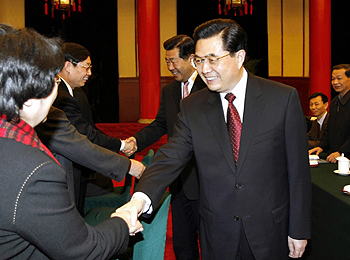
Chinese President Hu Jintao (R front) and Jia Qinglin (R rear), chairman of the National Committee of the Chinese People's Political Consultative Conference (CPPCC), shake hands with members of the China Democratic League and the China Association for Promoting Democracy who attend the Fourth Session of the Tenth National Committee of the CPPCC, in Beijing March 4, 2006. [Xinhua Photo]
Top Chinese leaders, including President Hu Jintao, top legislator Wu Bangguo and Premier Wen Jiabao, on Saturday joined panel discussions with the country's political advisors, who are holding their annual full meeting in Beijing.
The discussions of the advisors, or members of the Tenth National Committee of the Chinese People's Political Consultative Conference (CPPCC), China's political advisory body, also attracted the participation of CPPCC National Committee Chairman Jia Qinglin, Vice-President Zeng Qinghong, and other senior Party leaders Wu Guanzheng, Li Changchun and Luo Gan.
The eight leaders are all in the nine-member Standing Committee of the Political Bureau of the Communist Party of China (CPC) Central Committee, the top decision-making body of the ruling party.
"In order to attain the development goals set for the next five years, we shall unswervingly rely on the general public and sincerely bring benefits to the people," said President Hu while discussing the country's 11th Five-Year National Economic and Social Development Plan (2006-2010) with advisors from the non-Communist parties.
The draft development plan will be submitted to the upcoming annual full session of the Tenth National People's Congress (NPC), the national legislature, for deliberation and approval. The NPC session opens on Sunday.
The CPPCC members have contributed their ideas in the drafting process of the program, and will further discuss about it at their ongoing session, which opened on Friday and would last for 10 days.
Hu also stressed the importance of developing an "advanced socialist culture," which he said can play a key role in improving social ethics and enhancing patriotism among the people, particularly among the younger generations.
In other panel discussions, the other seven leaders discussed with the political advisors about such issues as democratic decision-making, the fight against "Taiwan independence," building of a "harmonious socialist society," cultural development and reforms, and the fight against corruption.
|